
White Papers
Best Practices for Validating Airport Surface Data and Gate Adaptations
Explore best practices for validating airport surface data and gate adaptations using GIS maps, satellite imagery, operational data, and quality checks.
Explore best practices for validating airport surface data and gate adaptations using GIS maps, satellite imagery, operational data, and quality checks.

GDPs are sometimes operated inefficiently, resulting in excessive delays. To address this issue, we propose a specific operational technique involving a “Blanket Adjustment” in GDP execution.
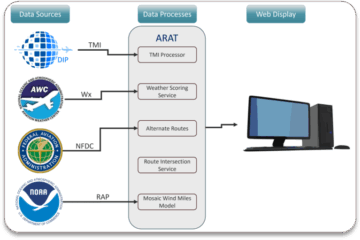
Discover how Mosaic ATM’s ARAT tool enhanced TMI parsing accuracy for C90 TRACON, boosting fix closure detection by over 220%. This white paper details parsing logic improvements, regional adaptation strategies, and their integration into the NAS TMI Service to support smarter, more efficient air traffic management nationwide.

In this white paper, we explore Mosaic ATM’s air traffic controller communications training tool, the Reconfigurable Interactive Communications Training Environment (RICTE), which leverages artificial intelligence to simulate realistic, multi-modal communication scenarios, enhancing the training effectiveness and proficiency of air traffic controllers.
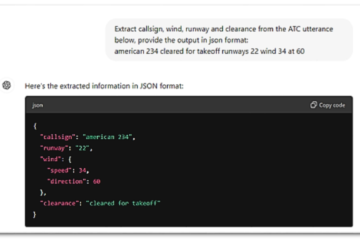
In this white paper, we explore using large language models and on-premises AI to transcribe and analyze pilot- controller communications, enhancing aviation safety and efficiency through real-time insights and secure, customizable deployment.

Mosaic ATM partnered with Touchstone Evaluations (Touchstone) to complete Phase I of the Visual Integration of Language Models in Automotive Safety (VILMAS) Small Business Innovation Research (SBIR) project, funded through the National Highway Traffic Safety Administration (NHTSA).

Aerial missions are becoming indispensable across industries, and optimizing operations for uncrewed aircraft and their supporting ground crews is critical. Mosaic ATM’s Uncrewed Aircraft Fleet & Flight Operations Optimization (UA-FFOpt) was designed to investigate this challenge by creating a proof-of-concept system aimed at optimizing large-region missions in terms of both aircraft flight time and ground crew costs.

In this paper, we provide a high-level description of the approach taken to provide real-time predictions and decision support for operators monitoring complex tactical situations.

Having an autonomous artificial intelligence (AI) system that can monitor individuals via facial mood recognition, vocal tonality analysis, proximity to one another, performance, biosensors, surveys, and more, and predict conflict before it is problematic could improve a unit’s cohesion and performance in missions both in space and in isolated environments on Earth.

This white paper explores how traditional models of the value of information (VoI) can be extended effectively to account for uncertainties presently inherent in gathering and analyzing big data. To illustrate the challenge, we explore the VoI an automobile manufacturer may derive by engineering a telematics system into its vehicles.